The Land Shifts - Suite for String Orchestra
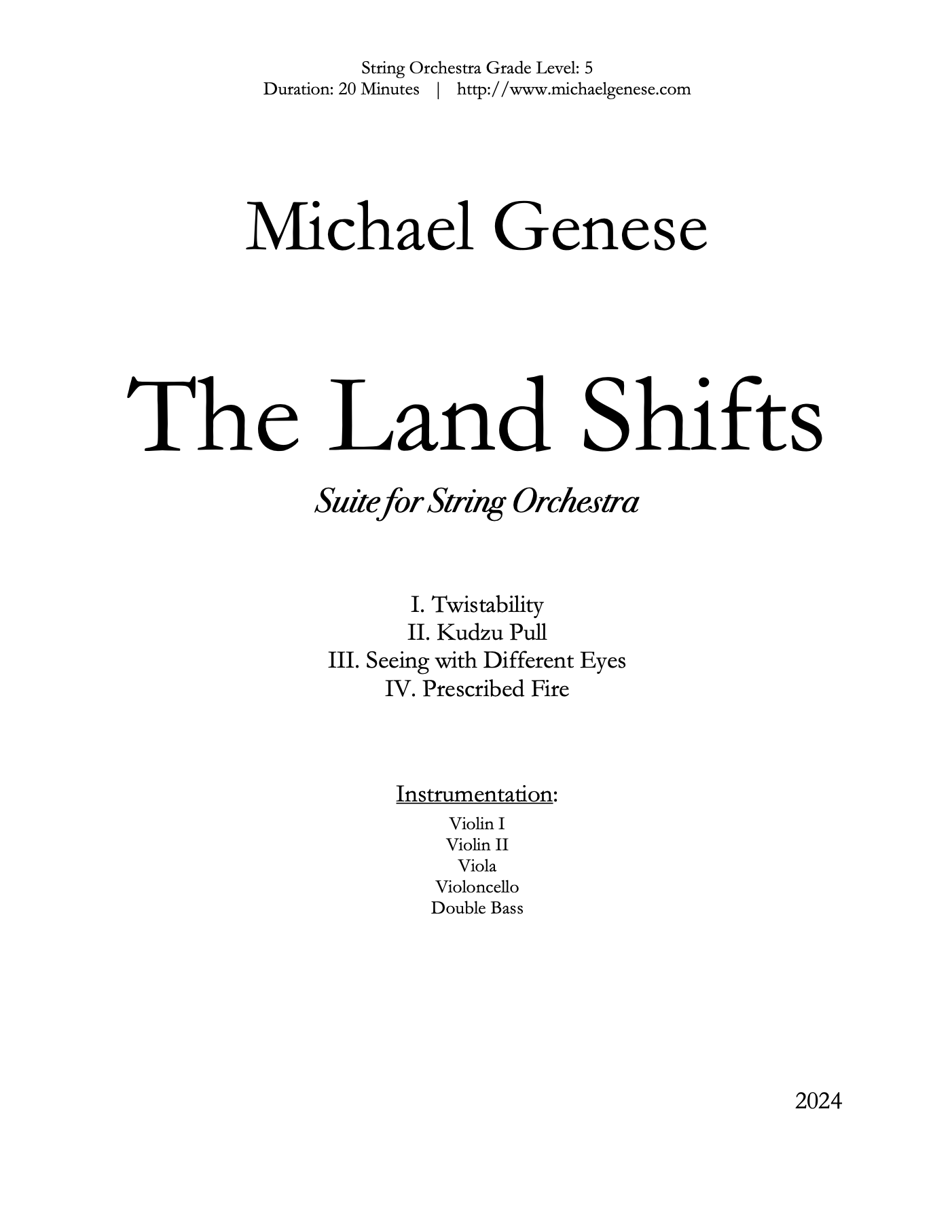
Ensemble: String Orchestra
Duration: 20 mins
Written: 2024
82 Pages, 8.5x11 PDF Format
Duration: 20 Minutes
Difficulty: Grade 5 (grading system details)
Written: 2024
Instrumentation:
-Violin I
-Violin II
-Viola
-Violoncello
-Double Bass
*Click on each title to view a score preview.
Ensemble: String Orchestra
Duration: 20 mins
Written: 2024
82 Pages, 8.5x11 PDF Format
Ensemble: String Orchestra
Duration: 20 mins
Written: 2024
Instrumentation: Violin I, Violin II, Viola, Violoncello, Double Bass
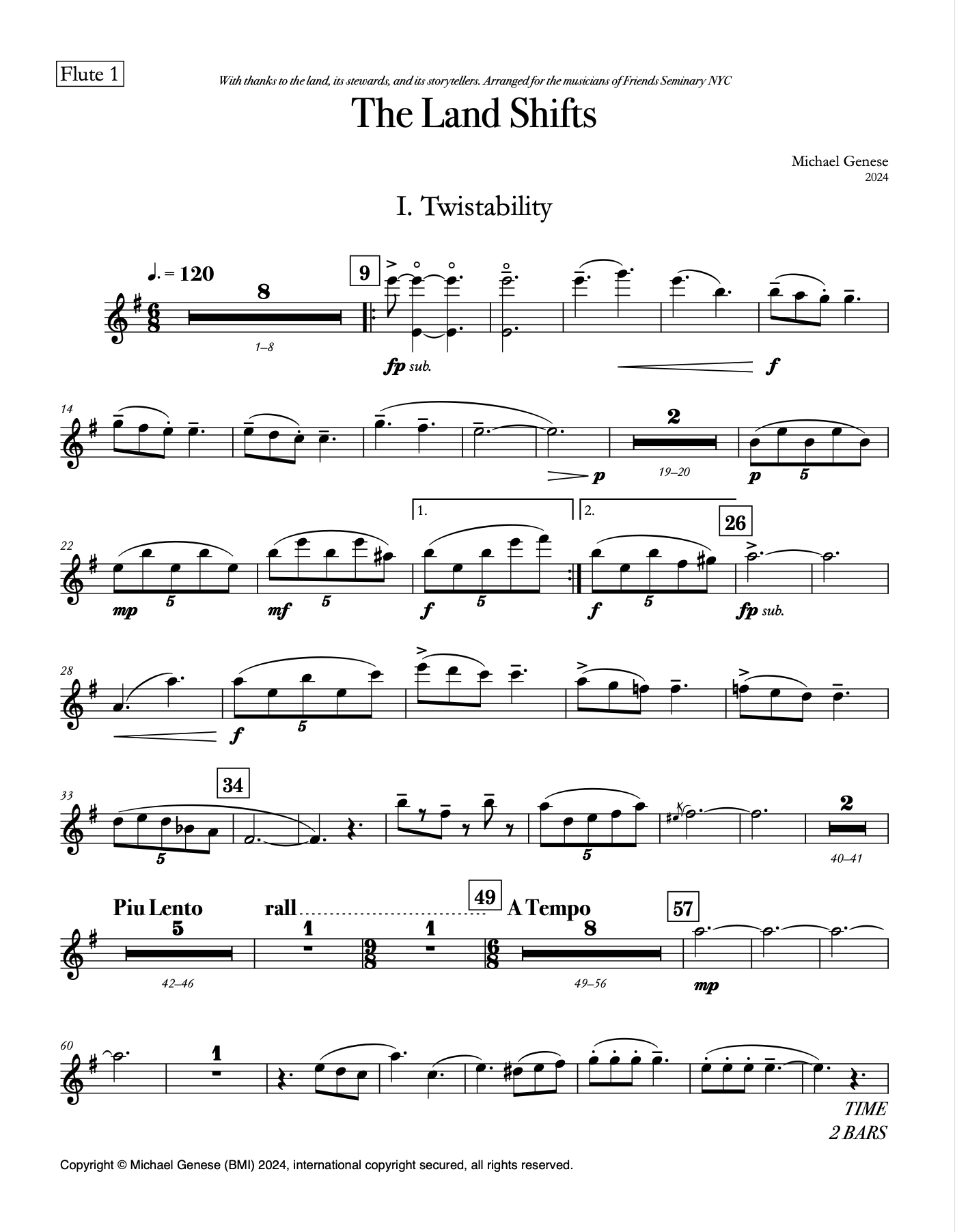
8.5x11 PDF Format.
Taken from an expanded edition of The Land Shifts, arranged for Friends Seminary NYC in September 2025.
-Flutes 1 and 2
-Oboe
-Classical Guitar
-Pianos (1, 2, and 3)
-Violin III (based on the Viola part with various adjustments)
*A Full Score including your needed instrumentation can be custom-made
Program Note:
2024 was the tenth anniversary of my working at the University of Rhode Island Summer Music Academy. As I drove back and forth to campus in July, I noticed a dense, viny ground cover on the sides of the highway that appeared to be charred and burnt at the very top. I wondered what it was, and worried if our unpredictable climate was to blame. The shape of the problem was revealed in due time.
Twisting, pulling, seeing, and burning: The Land Shifts explores these four land-based actions, where either the land or our perspective on it is altered.
Movement I. Twistability lashes out, frustrated and confused about the present. Writhing sforzando’s fade and return like the seasons, and a quintuplet motif (“Twist-a-bi-li-ty”) twists the six-beat bar into five. How "twistable" is our perspective, especially we learn what’s been hidden from us?
Movement II. Kudzu Pull envisions group of friends gathering to pull up kudzu. This plant—invasive to the Americas—takes over entire landscapes, choking out every competitor. When the kudzu is gone, which plants should be there? What is the land's history?
This brings us to Movement III. Seeing with different eyes. In her book Braiding Sweetgrass, Robin Wall Kimmerer recounts the following:
“One morning in March I stopped by Tom’s place to talk about planting [...] in the spring. I was full of plans for an experimental restoration. [...] We put on our jackets and walked out over the fields. With the right eyes you can almost unsee Route 5, the railroad tracks, and I-90 across the river. You can almost see fields of Iroquois white corn and riverside meadows where women are picking sweetgrass. [...] But the fields where we walk are neither sweetgrass nor corn."
-Robin Wall Kimmerer, Braiding Sweetgrass (2013) pg. 259-260
To know the land we are on, we have to practice unseeing, and notice how the land shifts. What defines a place like america, if not endless roadways, plastic, and overdevelopment? How can a place be both so loud and so silent?
Movement IV. Prescribed Fire is named after an ancient land management technique, where portions of land are burned during the cold and wet season. This prevents larger wildfires by reducing the amount of flammable ground cover, and also feeds the seed bank underneath with nutritious ash.
Growing up, I thought global warming was to blame for summer wildfires. In adulthood, I learned that Indigenous people routinely introduced fire to the landscape for its benefit. When millions of them were taken from these lands, the ground-cover was not routinely burned, and the flammable material on the forest floor was not maintained. Today, Indigenous people make up only 5% of the world's population, but protect approximately 85% of the world's biodiversity.
On the final drive back from the string academy, things clicked for me. That ground cover was an invasive species––either Knotweed or Kudzu. Rather than being pulled or burned to make room for native species, the state government sprayed it with chemicals before it reached the highway. The climate was not drying the plant out; the land was being mismanaged. This heartbreaking shift in perspective on the highway is what inspired this piece of music, which I hurriedly sketched on a friend's keyboard later that afternoon.
If we are to love the land as it deserves, sovereignty movements like Land Back must drive our thinking, our actions, and our refusals. Singeing the edges of our problems will never be enough. We have to love pulling them up by the roots.